CALL 310.849.4915 FOR DIRECT BOOKINGS
BOOK LAWRENCE FOR YOUR NEXT TRAINING CONFERENCE TODAY!
Lawrence J. Moran, M.S. is a forensic psychology professional, author, and speaker specializing in complex behavioral analysis within high-risk populations. His work focuses on female and adolescent offending patterns, maternal filicide, and serial homicide, integrating decades of clinical, correctional, and field experience into an applied behavioral framework.
He is the author of Saving Generation Next and the upcoming work Just Between Us: Inside the Minds of Female Sexual Predators, which explores nuanced dimensions of female deviant behavior and risk cognition within forensic populations.
With a multidisciplinary background spanning psychology, criminal justice, juvenile and adult drug court systems, crisis intervention, and forensic consultation, Lawrence brings a systems-based, real-world perspective to the study of violent and aberrant behavior. His work bridges clinical theory, investigative psychology, and applied case analysis.
In addition to research and writing, he is developing conference presentations and youth motivational speaking programs focused on decision-making, behavioral accountability, and resilience in at-risk populations.
FOLLOW ME ON SOCIAL MEDIA


CURRENT RESEARCH
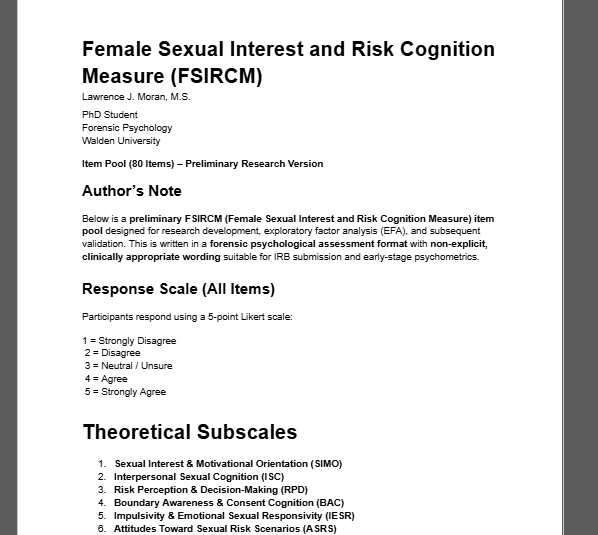
Lawrence J. Moran, M.S. is actively engaged in advanced forensic research examining complex and understudied domains of sexually deviant and violent behavior. His current work centers on the early identification and behavioral profiling of female sexual offending patterns, including the development of an applied personality-based assessment framework designed to evaluate risk cognition, deviant sexual interest, and psychopathic traits in female populations.
A primary area of investigation involves the construction and validation of a specialized forensic personality instrument aimed at identifying traits associated with female sexual predation, with particular emphasis on affective instability, interpersonal manipulation, entitlement schemas, and deviant bonding patterns observed in incarcerated and clinical populations. This work seeks to address significant gaps in existing psychometric tools, which have historically been normed primarily on male offender populations.
Moran’s research further explores the intersection of psychopathy and female offending behavior, integrating dimensional models of personality pathology with behavioral case analysis to better understand pathways to coercive and predatory sexual conduct. This includes comparative analysis of female sexual offenders against male pedophilic populations and broader antisocial cohorts.
Additional ongoing areas of study include maternal filicide, with attention to psychological, situational, and developmental risk factors contributing to lethal maternal behavior, as well as adolescent sexual offending trajectories, particularly early-onset behavioral indicators, trauma-linked pathways, and cognitive distortions associated with sexual aggression in youth populations.
Collectively, this body of work contributes to a developing framework aimed at improving forensic assessment, investigative profiling, prevention strategies, and clinical intervention models for rare and high-impact forms of interpersonal violence.